
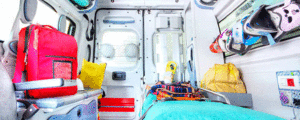
What equipment should be inside an ambulance? At Salvador Navarro we explain the essential equipment that must be in an ambulance for it to be effective. To begin with, there are several types of ambulances, depending on the specific requirements and the regional health authority.
Types of Ambulances
- SAMU: These are the ambulances dispatched by the coordinating centre for emergency interventions.
- Patient Transport Vehicle (PTV): Used to transport stable patients and staffed without medical personnel.
- SAMU-ICI / Mobile ICU: These are the most critical units, staffed by a paramedic, a physician, and a nurse, capable of providing all types of emergency care.
Equipment That Should Be in an Ambulance
- Medicinal oxygen cylinders: These are connected to the vehicle to supply the various wall outlets.
- Cervical collars: They help keep the victim rigid along the head-trunk axis, which is essential to prevent neck injury in accident victims and avoid vertebral fractures.
- Splints: These immobilise the fractured part of the body using a mechanism similar to the vacuum mattress — a mattress filled with small beads that conforms to the patient’s shape and becomes rigid when the air is removed. It is ideal for transporting patients who must not be moved excessively.
- IV fluids of all types: These are kept on top of the mattress alongside wound care supplies such as bandages, gauze, betadine, etc.
- Spinal board: The patient is placed on this if the spine is damaged, as a soft mattress is not appropriate in such cases.
- Scoop stretcher: Similar to the spinal board, the only difference is that it opens in the middle and is used to lift the patient from the ground while moving them as little as possible.
- Folding chair: Used to evacuate the victim from a building, as a stretcher cannot fit in a lift.
- Backpacks: These contain all the necessary supplies for the interventions the victim may require. They are the most important piece of equipment in an ambulance, similar to the contents of a first aid kit. They may include:
- Self-inflating bag: Used to insufflate air into the victim’s lungs; it allows an increase in oxygen concentration and includes a mask to prevent air from escaping when pressure is applied. - Tracheal tube and laryngoscope: These allow the tongue to be displaced for a clearer view of the larynx. - Mask: Once the patient is conscious and breathing, the mask is placed on them and connected to the oxygen cylinder. - Bandages, gauze, and plastic tubes for intravenous access when needed.
- The equipment in an ambulance must include hooks, which should be positioned on the lateral walls of the vehicle, for hanging IV fluid bags. In the upper section you will find chemical heat or cold packs, and triage labels for classifying casualties in the event of a mass-casualty incident.
- Sphygmomanometer and pulse oximeter: Both are automatic and measure blood pressure and blood oxygen saturation. There are many types depending on the function required.
- Suction unit: Used to aspirate secretions and perform suctioning, among other functions.
- Ampule rack: A plate with rubber holes to hold medication ampoules by the neck.
- Automatic ventilator: When the patient is unable to breathe independently, they are connected to this device, which delivers oxygen twelve times per minute.
- Defibrillator: Can save lives when used in time, when the victim’s heart has stopped beating. It consists of two electrodes, capacitors, and a monitor.
At Salvador Navarro, you will find all the equipment needed for an ambulance. If you would like more information, do not hesitate to get in touch with us.